Friday, November 9, 2007

Forex Chart Tred Lines

Plotting a trend line on a Forex chart gives very valuable information.
Not only the trend line will show a current trend (direction) of the price move, it will also depict points of support and resistance levels for market price.

In addition, it will also help to determine good entry and exit points, best positioning for profit taking and placing protective stops.
This very simple, but yet quite powerful tool will be one of the crucial indicators of possible trend reversal (when market price starts move in the opposite direction).

So, shall we learn how to draw trend line to make it our good friend in profitable forex trading?

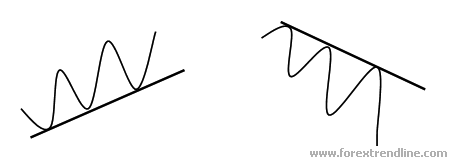
In the uptrend market trend line is drawn below the pattern formation; in the downtrend — above. (That is why when the trend is going to change our trend line will be crossed, which therefore will give us a signal that the price can start moving in another direction.)

Drawing uptrend/downtrend line

In the uptrend, Forex trend line is drawn through the lowest swing-points of the price move.
Connecting at least two «lowest lows» will create a trend line.

In the down trend, trend line is drawn through the highest swing-points of the price move.
Connecting at least two «highest highs» will create a trend line.

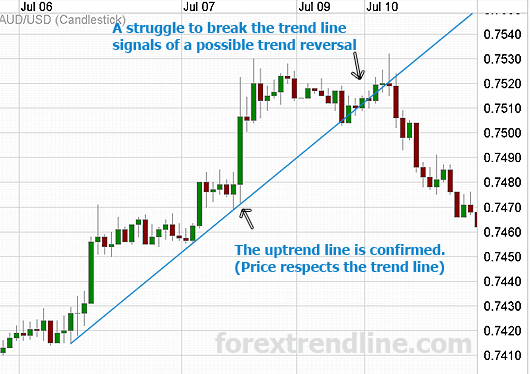
A trend line confirms its validity when the price respects this line. The more «lowest lows» / «highest highs» the trend line contains, the stronger it becomes.

Valid uptrend line

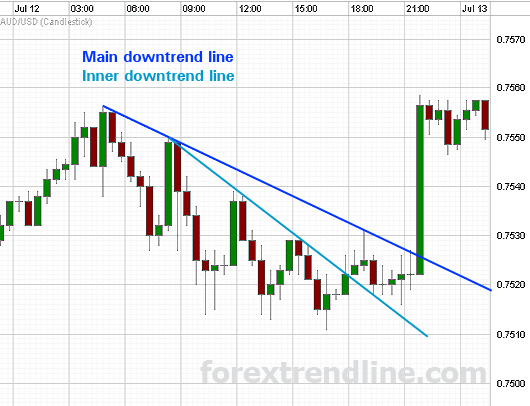
Another sample of drawing trend lines: main and inner downtrend lines.

Main and inner downtrend lines

FOREX TIPS

Tip 1. Gamblers go to casino. All unproved, spontaneous actions in Forex trading — are a part of pure gambling.
Any attempt to trade without analysis and studying the market is equal to a game. Game is fun except when you are losing real money...

Tip 2. Never invest money into a real Forex account until you practice on a Forex Demo account!
Allow at least 2 month for demo trading. Consider this: 90% of beginners fail to succeed in the real money market only because of lack of knowledge, practice and discipline. Those remaining 10% of successful traders had been sharpening and shaping their skills on demo accounts for years before entering the real market.
A good demo account to start practicing with could be, for example, FXGame from Oanda.

Tip 3. Go with the trend!
Trend is your friend. Trade with the trend to maximize your chances to succeed. Trading against the trend won't "kill" a trader, but will definitely require more attention, nerves and sharp skills to rich trading goals.

Tip 4. Always take a look at the time frame bigger than the one you've chosen to trade in.
It gives the bigger picture of market price movements and so helps to clearly define the trend. For example, when trading in 15 minute time frame, take a look at 1 hour chart; trading hourly would require obtaining a picture of daily, weekly price movements.

If a trend is hard to spot — choose a bigger time frame. Up and down market patterns are always present. Always make sure you know the dominant trend, unless you are a scalper. Scalpers have no need to spend their time studying big trends, what's happening in the market here and now (during 5-10 minute time frame) should be of only importance to a Forex scalper.

Tip 5. Never risk more than 2-3% of the total trading account.
One important difference between a successful and an unsuccessful trader is that the first is able to survive under unfavorable conditions on the market, while an unsuccessful trader will blow up his account after 5-10 unprofitable trades in the row.

Even with the same trading system 2 traders can get opposite results in the long run. The difference will be again in money management approach. To introduce you to money management, let's get one fact: losing 50% of total account requires making 100% return from the rest of money just to restore the original balance.

Tip 6. Put emotions down. Trade calm.
Don't try to revenge after losing the trade. Don't be greedy by adding lots of positions when winning.
Overreaction blocks clear thinking and as a result will cost you money. Overtrading can shake your money management and dramatically increase trading risks.

Tip 7. Choose the time frame that is right for you.
Choosing wise means that you are comfortable and have time enough to analyze the market, place and close orders etc. Some people can't wait for hours for the price to make a move, they like action and therefore prefer smaller time frames. On the contrary, for others 10-15 minutes is a hustle to be able to make the right decision.

INTRODUCTION

The foreign exchange (currency or forex or FX) market exists wherever one currency is traded for another. It is by far the largest financial market in the world, and includes trading between large banks, central banks, currency speculators, multinational corporations, governments, and other financial markets and institutions. The average daily trade in the global forex and related markets currently is over US$ 3 trillion.[1] Retail traders (individuals) are a small fraction of this market and may only participate indirectly through brokers or banks, and are subject to forex scams.

Market size and liquidity

The foreign exchange market is unique because of

  • its trading volume,
  • the extreme liquidity of the market,
  • the large number of, and variety of, traders in the market,
  • its geographical dispersion,
  • its long trading hours: 24 hours a day (except on weekends),
  • the variety of factors that affect exchange rates.
  • the low margins of profit compared with other markets of fixed income (but profits can be high due to very large trading volumes)

According to the BIS,[1] average daily turnover in traditional foreign exchange markets is estimated at $3,210 billion. Daily averages in April for different years, in billions of US dollars, are presented on the chart below:

This $1.88 trillion in global foreign exchange market "traditional" turnover was broken down as follows:

In addition to "traditional" turnover, $2.1 trillion was traded in derivatives.

Exchange-traded forex futures contracts were introduced in 1972 at the Chicago Mercantile Exchange and are actively traded relative to most other futures contracts. Forex futures volume has grown rapidly in recent years, and accounts for about 7% of the total foreign exchange market volume, according to The Wall Street Journal Europe (5/5/06, p. 20).

Average daily global turnover in traditional foreign exchange market transactions totaled $2.7 trillion in April 2006 according to IFSL estimates based on semi-annual London, New York, Tokyo and Singapore Foreign Exchange Committee data. Overall turnover, including non-traditional foreign exchange derivatives and products traded on exchanges, averaged around $2.9 trillion a day. This was more than ten times the size of the combined daily turnover on all the world’s equity markets. Foreign exchange trading increased by 38% between April 2005 and April 2006 and has more than doubled since 2001. This is largely due to the growing importance of foreign exchange as an asset class and an increase in fund management assets, particularly of hedge funds and pension funds. The diverse selection of execution venues such as internet trading platforms has also made it easier for retail traders to trade in the foreign exchange market. [4]

Because foreign exchange is an OTC market where brokers/dealers negotiate directly with one another, there is no central exchange or clearing house. The biggest geographic trading centre is the UK, primarily London, which according to IFSL estimates has increased its share of global turnover in traditional transactions from 31.3% in April 2004 to 32.4% in April 2006. RPP

The ten most active traders account for almost 73% of trading volume, according to The Wall Street Journal Europe, (2/9/06 p. 20). These large international banks continually provide the market with both bid (buy) and ask (sell) prices. The bid/ask spread is the difference between the price at which a bank or market maker will sell ("ask", or "offer") and the price at which a market-maker will buy ("bid") from a wholesale customer. This spread is minimal for actively traded pairs of currencies, usually 0–3 pips. For example, the bid/ask quote of EUR/USD might be 1.2200/1.2203. Minimum trading size for most deals is usually $100,000.

These spreads might not apply to retail customers at banks, which will routinely mark up the difference to say 1.2100 / 1.2300 for transfers, or say 1.2000 / 1.2400 for banknotes or travelers' checks. Spot prices at market makers vary, but on EUR/USD are usually no more than 3 pips wide (i.e. 0.0003). Competition has greatly increased with pip spreads shrinking on the major pairs to as little as 1 to 2 pips.